
Friday, February 21, 2014
A Village for People with Dementia
In light of the number of people designing for mental conditions or at the very least dealing with mental experiences in architecture, this article (courtesy of Gizmodo) might be of interest to a significant portion of the class. Though focused on Alzheimer's what is interesting about this is the community that may emerge despite the population's condition. This is a dramatic shift from the "preventative" methods of dealing with the population such as decoy bus stops...


Student Innovation & Collaboration LAB (SIC-LAB) - Bio-Logic Architecture
Student
Innovation & Collaboration LAB (SIC-LAB)
Issue
Buildings today
are still built in a post-modernist state of mind, based on ideas fueled by
cheap and endless supply of fossil fuels. They are unable to deal with adaptive
pressures from unexpected circumstances and changes to the economy and local
ecology. The travesty is that the produced architecture is designed
specifically to work through a production line which degrades the quality of
the output.
Student Innovation & Collaboration LAB
Ryerson
University contains various MakerSpaces, HackerSpaces, Fabrication labs and
TechShops. The essence for these spaces is to be as collaborative as possible
and bring together various departments within the school to produce new
technology. The issue is that these spaces are typically hidden away within
multiple buildings within the campus thus the essence of collaboration is non-existent.
Much like the requirement for a central library for the campus, the proposal
brings together all the innovation spaces and produces a single collaborative environment.
The architecture will be an example of how biological procedures can be applied
to a building to support the collaborative spirit of the building.
The site is
located on the intersection of Gould and Yonge. This will play an important
role as it becomes part of the gateway into the main campus.

Bio-Logic
Architecture
“A building functions like an organism therefore it
could be organised to comply with similar laws to
those that regulate living systems.”
- Marcos Cruz on Le Corbusier
Architecture
can benefit from being thought of as living organisms whose functions and
behaviors are determined by the relationship between the parts within a whole.
The process of adding a bio-logic to both the makeup of the internal program
and the membrane to deal with energy transfers and maintaining the internal quality
resonates with the resilience and self sustenance that is abundantly evident in
natural systems.
Strategy #1: Architecture that is resilient allowing for flexibility and change through time
Resilience is prevalent in nature as natural systems are better able to adapt and accommodate unforeseen changes within and by externalities.
Tactic #1: Geometry
of resilience – Physical adjacency promotes interaction and self organization. The
architecture will be designed to consider the adjacent site conditions and
the internal organization will unfold in sequential sizes.

Tactic #2: Economy
of differentiation – differentiation creates diversity which allows for more
efficient adaptation to varying conditions. The architecture will produce
adaptable spaces that cater to different users and differing programmatic requirements.
Tactic #3:
Agile approach to design – The architecture will provide spaces that create the
conditions in which behaviour is most likely to be generated in, as opposed to
specifying the behaviour that is desired. The architecture will allow for
collaboration by creating networked spaces and tactile surfaces that are conducive
to the generation of ideas and solutions.
Strategy #2: Architecture that delights through continuity
Natural systems flow from one state to another in fluid motion as opposed to binary steps that is common with digital networks. The senses register delight in formed relationships between objects which become elements that exist in a continuum.
Tactic #1: Sensuousness
of continuum – The parts of the whole have to be in gradual states of
continuity, they need to have middles but they should not end as the sensuousness
is generated by the highlighting of the middle and the vectoring of the ends. The
architecture will produce elements that flow so there is no points, but
continuous lines. (Idea of folds as opposed to corners)
Tactic #2: Architecture
of weaving – To enable natural light to further inhabit the interior of the
building, the structure needs to develop rhythm and produce voids creating an
internal, negative building. The architecture will use “figures” where
by the structure ends on the horizontal plane in various forms to avoid a
linear connection.
Strategy #3: Architecture in biological epistasis allowing for optimized transfers of energy
By optimizing systems to work harmoniously, the architecture (bio)mimics nature allowing for flows of energy that functions intuitively and increase the comfort levels through daylighting strategies.
Tactic #1: Regulate
homeostasis – Utilizing the local air conditions for specific use internally to
aid in regulating comfort levels. The architecture will redistribute
external air condition and optimize for use internally.
Tactic #2: Passive
methods of self-sustenance – Using the natural resources available to the building,
utilizing the external sources to generate energy. The architecture will use
natural daylight strategies and incorporate solar panels for energy
generation.
Thursday, February 20, 2014
Sentire Elementary School
Sentire Elementary School
Issue:
Building climates are typically
controlled by centralized mechanical systems that lead to extensive energy consumption
and
lack individual control and diverse
sensual experience of space.
Architects are required to satisfy eighty percent of the occupants, thus
compromising the health and productivity of the
remaining twenty percent. Human comfort
can enhance the experience of space, increase concentration and performance, and improve
occupants’ health.
Consequently, human comfort affects the individual, the economy, and our
society at large.
Sentire Elementary School architectural
context:
The Toronto District School Board
advocates equitable and inclusive education.
Sentire Elementary School fosters equality and inclusion through its
ambition to design spaces that are climatically comfortable to all occupants,
in attempt to enhance students’ concentration and learning abilities. Adaptive spaces will respond to various activities
and their optimal weather requirements.
The school will visually demonstrate changing climatic conditions to
foster students’ awareness and understanding of weather parameters, and to
encourage them to playfully change their surroundings; thus increasing their
understanding of the impact they have on the environment.
Sentīre (Latin)
· Perceive,
feel, experience
· Think,
realize, see, understand[1]
Site:
The Sentire Elementary
School will be located in the emerging West Don Lands neighbourhood. The West Don Lands Precinct Plan indicates
that the community will have approximately 860 elementary school children, and
that the building will be constructed when 250 children require school. The Sentire Elementary School will be
designed for 250 students, yet account for future expansion. The plan calls for designs that foster innovation
and creativity and for “smart” buildings and education. The Sentire Elementary School will strive to
meet these criteria through its form and materiality, and through its playful
interaction between building and students that make invisible climatic
phenomena visible.

Client:
Toronto District School Board
Strategy 1:
Respond to the ideal temperature levels based on the human
circadian rhythm and the type of activity taking place in each space.
Educational | architectural
context:
Elementary school operates between approximately 8:00 a.m. – 4:00
p.m. During this time the body is
primarily in heat-gain mode, and students are generally most active. Human comfort will depend on individual
parameters such as metabolic rate and clothing, and on external parameters
including temperature, air movement, and relative humidity. The building can respond to students’
metabolic rate by adapting the climate, for example through reducing the
temperature and increasing air movement after breakfast and lunch. Furthermore, the building can respond to
types of activity; higher levels of activity such as exercise and play require
lower temperature and relative humidity than calm activities including studying
and performing arts.
Tactic
#1:
Organize the school according
to the various activities and their corresponding climatic necessities.

Tactic
#2:
Create a relationship between
spaces such that thermal conditions in one place can transfer to another as
necessary.
Tactic
#3:
Design the building’s form
and envelope to utilize external weather conditions to reduce the building’s
reliance on fossil fuels.
Strategy 2: Design spaces that adapt to
several climatic requirements.
Educational | architectural context:
Several activities that require different climatic conditions take
place in classrooms, such as studying and playing, and necessitate adaptive
surroundings. Teachers nowadays
typically control a classroom’s climate by opening windows or managing the HVAC
system. Spaces can naturally adapt to
the occupants’ needs based on the activity taking place; thus creating comfortable
spaces both when teachers are and are not around.
Tactic
#1:
People produce varying
degrees of vapor based on their activity.
Sensors that track the vapor level can change the climatic conditions of
the space as necessary.
Tactic
#2:
Provide a control panel that
will override the sensors and condition the space based on a prescribed
activity.
Tactic #3:
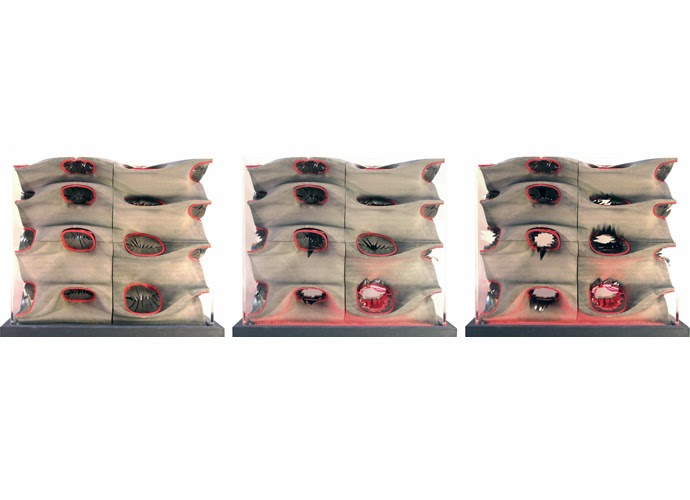
Utilize smart materials that respond to climatic stimuli.
 |
|
Glass Panel Shutter System [Illustration]. dO|Su
STUDIO ARCHITECTURE. Retrieved February 20, 2014, from http://www.dosu-arch.com/smartwindow.html
|

 |
|
Tracheolis [Illustration]. dO|Su STUDIO
ARCHITECTURE. Retrieved February 20, 2014, from
http://www.dosu-arch.com/tracheolis.html#
|
Strategy 3: Visualize climatic conditions
to stimulate a rich sensual experience.
Educational | architectural context:
Visualizing relative humidity, temperature, and air movement
velocity will foster occupants’ awareness of interior climate and an
understanding of their individual comfort level. Building components can playfully react to
climatic conditions to encourage students’ engagement with and transformation
of the building.
Tactic
#1:
Utilize smart materials that
respond to climatic stimuli.
[1] Latin
definition for: sentio, sentire, sensi, sensus. (n.d.). Latin Definition
for: sentio, sentire, sensi, sensus (ID: 34697). Retrieved February 20,
2014, from
http://www.latin-dictionary.net/definition/34697/sentio-sentire-sensi-sensus
Subscribe to:
Posts (Atom)